
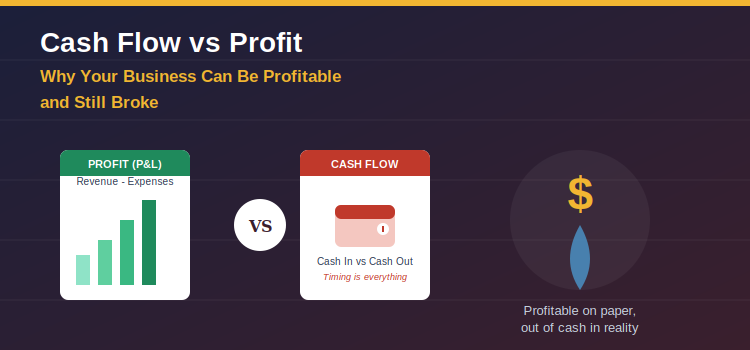
Profit and cash flow measure two different things. Profit is what’s left after subtracting expenses from revenue on your income statement an accounting figure, not a bank balance. Cash flow is the actual movement of money into and out of your bank account. A business can show a healthy profit on paper while having no usable cash, because revenue is often recorded before the money is collected and some cash outflows (like loan principal or inventory purchases) never appear on the profit and loss statement at all. This mismatch sometimes called being “profitable but broke” is one of the leading reasons financially sound-looking businesses run into serious trouble.
Why This Confusion Is So Common (and So Costly)
Most business owners equate “profitable” with “financially healthy.” It’s an understandable assumption, but it’s wrong often enough to be dangerous: cash flow problems are cited as a contributing factor in roughly 82% of small business failures, according to a widely referenced U.S. Bank study. Separate research from the JPMorgan Chase Institute found the median small business holds only about 27 cash buffer days enough to survive roughly four weeks with zero incoming cash and that buffer shrinks to as little as 13–16 days for cash-intensive industries like restaurants. Meanwhile, Federal Reserve survey data shows that over half of employer firms cite managing uneven cash flow as a top ongoing challenge.
The uncomfortable pattern researchers keep finding: businesses rarely collapse from one dramatic event. They decline gradually a slow-paying client, a hiring decision made against optimistic revenue projections, a credit line quietly maxed out and post positive net income right up until the point the doors close. Understanding the difference between profit and cash flow isn’t an academic accounting distinction. It’s often the difference between catching a liquidity problem early and finding out about it when you can’t make payroll.
What Is Profit?
Profit is what remains after you subtract expenses from revenue over a specific period, and it’s shown on your profit and loss statement (P&L), also called an income statement. There are three commonly tracked layers:
- Gross profit — revenue minus the direct cost of producing your goods or services
- Operating profit — gross profit minus operating expenses like rent, salaries, and marketing
- Net profit — what’s left after everything, including interest and taxes
Profit is an accounting concept, and it follows accrual accounting rules: revenue is recorded when it’s earned (e.g., when you deliver a service or ship a product), not necessarily when the cash actually lands in your bank account. That timing gap is the root of nearly every “profitable but broke” story.
What Is Cash Flow?
Cash flow is the actual movement of money into and out of your business, tracked on the cash flow statement. It answers a much more immediate question than profit does: do you have enough usable money right now to cover payroll, rent, suppliers, and taxes?
Cash flow is typically broken into three categories:
- Operating cash flow — cash generated or used by core business activities
- Investing cash flow — cash spent on or received from long-term assets (equipment, property)
- Financing cash flow — cash from loans, investor funding, or debt repayment
Unlike profit, cash flow doesn’t care about accounting rules or recognition timing it only cares about when money actually changes hands.
Profit vs. Cash Flow: Side-by-Side
| Profit | Cash Flow | |
|---|---|---|
| What it measures | Whether the business model works | Whether the business can pay its bills right now |
| Shown on | Profit and loss statement (P&L) | Cash flow statement |
| Accounting basis | Accrual (revenue recorded when earned) | Cash (recorded when money moves) |
| Time orientation | Performance over a period | Liquidity at a given moment |
| Can be positive while the other is negative? | Yes | Yes |
| What it’s used for | Assessing performance, comparing to competitors | Assessing survival, day-to-day operations |
Neither number is “better” than the other they simply answer different questions, and a business needs to track both to get a true picture of its financial health.
Real Reasons a Profitable Business Can Still Run Out of Cash
1. Slow-Paying Customers (Accounts Receivable)
If you invoice on 30-, 60-, or even 90-day terms, you record the sale and the profit the moment you deliver the work. But the cash doesn’t exist in your account until the customer actually pays. A business that completes $100,000 of work in a month can look highly profitable on paper while having none of that money available to spend.
2. Inventory and Upfront Purchases
Buying stock or materials ties up cash long before it turns into revenue. The purchase often isn’t fully reflected as an expense on the P&L in the period you paid for it but the cash is gone immediately.
3. Loan and Debt Principal Payments
Only the interest portion of a loan payment shows up as an expense on your income statement. The principal repayment is a real cash outflow every month, but it never appears on the P&L at all a common and often-missed source of the profit/cash gap.
4. Large Capital Purchases
Buying equipment, vehicles, or property is typically depreciated over several years on the P&L meaning only a fraction of the cost hits your profit figure each year while the actual cash often leaves your account in one lump sum upfront.
5. Growth Itself
Growth usually requires cash before it produces cash: hiring ahead of demand, buying more inventory, ramping up marketing spend, or taking on subcontractors before a project is billed. A business can be doing “better than ever” by every performance metric and still feel squeezed for cash, because growth consumes liquidity before it returns it.
6. Upfront Payments Creating Deferred Revenue
The reverse scenario also causes confusion: if a customer pays $120,000 upfront for a year-long contract, your bank account shows the full amount immediately, but accounting rules only let you recognize a portion of that as revenue each month as the service is delivered. The rest sits on the balance sheet as a liability (deferred revenue) cash-rich, but not yet “profit.”
7. Taxes
Tax obligations build up over the year based on profit, but the actual cash payment often comes due in a lump sum a bill that doesn’t feel urgent until the deadline arrives and the cash isn’t set aside.
Warning Signs You’re Profitable but Cash-Poor
- You’re showing a profit on your P&L but frequently over drafting or maxing out a credit line
- Accounts receivable is growing faster than revenue
- You’re delaying payments to suppliers to cover payroll
- You have to check your bank balance before making routine purchases, despite “good” numbers on paper
- Your cash buffer (cash on hand ÷ average daily expenses) is shrinking month over month
If two or more of these sound familiar, it’s a sign your business needs a real cash flow forecast not just a profit review.
How to Manage Both Profit and Cash Flow
- Build and review a cash flow forecast regularly — weekly or monthly, not just at tax time. Experts increasingly recommend monitoring cash flow weekly rather than monthly, since the gap between the two metrics can move fast.
- Tighten receivables — shorten payment terms, invoice promptly, follow up on overdue accounts, or offer small early-payment discounts.
- Time large purchases deliberately — sequence inventory and capital purchases around your actual cash position, not just your budget.
- Keep a cash reserve — a buffer of one to a few months of operating expenses gives you room to absorb slow-paying clients or a seasonal dip without a crisis.
- Separate the two reports in your regular review — look at your P&L and your cash flow statement side by side, not just one or the other, so a healthy profit number can’t mask a shrinking bank balance.
- Use a line of credit proactively, not reactively — a credit line arranged before a cash crunch is far easier to secure than one requested during one.
Why Professional Accounting Solutions Matter Here
The profit-vs-cash-flow gap is exactly the kind of blind spot that’s easy to miss when you’re managing the books yourself and hard to unwind once it’s already caused a shortfall. A qualified bookkeeper keeps your records current and your receivables visible so slow-paying invoices get caught early rather than discovered when the bank balance runs dry. An accountant or advisory-focused CPA can go a step further building a rolling cash flow forecast, separating recurring cash needs (payroll, debt principal, taxes) from one-time expenses, and flagging when growth or a large purchase is about to outrun your liquidity. Accounting software can generate a cash flow statement in seconds, but interpreting what it means for the next 30, 60, and 90 days is where professional judgment earns its keep. For any business that’s ever felt “busy but broke,” pairing clean bookkeeping with proactive accounting support is often the single highest-leverage move available it turns a lagging, reactive view of cash into a forward-looking one, catching problems while there’s still time and options to fix them.
Leave A Comment