
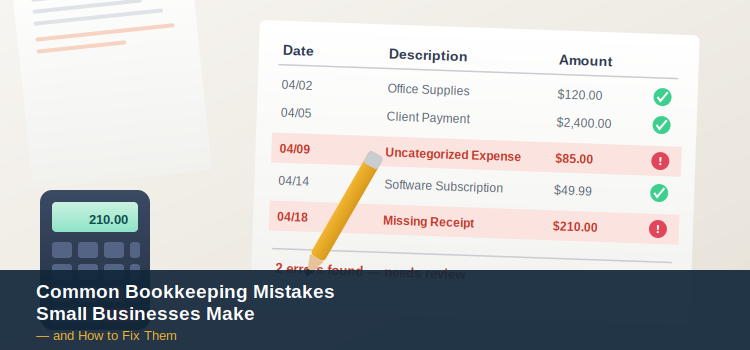
The most common bookkeeping mistakes small businesses make are mixing personal and business finances, falling behind on data entry, skipping bank reconciliation, miscategorizing expenses, using a poorly structured chart of accounts, ignoring accounts receivable/payable, missing sales tax obligations, and never reviewing financial reports. None of these are technical failures they’re process gaps that compound quietly, and every one of them is fixable with the right habits, software setup, or professional support.
Why These Mistakes Are So Easy to Miss
Bookkeeping mistakes rarely announce themselves. Poor bookkeeping has been identified as one of the leading reasons small businesses fail, second only to running out of cash. But it doesn’t feel that serious in the moment a single mis-coded expense, a reconciliation pushed to “next week,” a receipt that never gets logged. Each one, alone, looks harmless.
The problem is compounding. Small businesses account for roughly half of all private-sector jobs, yet a large share are still run by owners doing their own books with no formal training often without realizing how quickly small process lapses erode the reliability of their numbers. The cost is rarely immediate. It shows up later, as misread performance, a denied deduction, a bank balance that’s mysteriously off, or a tax season that turns into a weeks-long scramble. By the time it’s obvious, it’s already expensive to fix.
Here are the mistakes that show up most often and exactly how to fix each one.
1. Mixing Personal and Business Finances
The mistake: Running a business expense through a personal card, or covering a personal purchase with the business account. This is consistently cited as the single most common bookkeeping mistake, and often the hardest to unwind.
Why it matters: Every mixed transaction has to be manually sorted out later, which eats hours you don’t have. Beyond the mess, it can jeopardize your tax deductions the IRS requires clear separation to substantiate business expenses and for LLCs or corporations, consistently commingling funds can put your personal liability protection at risk by “piercing the corporate veil.”
The fix: Open a dedicated business checking account and a business credit card, and set a firm rule that personal spending never touches either. If you’ve already been mixing funds, the cleanup means going transaction-by-transaction through every account that touched the business tedious, but far better done now than during a tax filing or audit.
2. Falling Behind on Data Entry
The mistake: Letting receipts, invoices, and transactions pile up instead of recording them consistently often turning into “I’ll catch up this weekend” that stretches into months.
Why it matters: The longer transactions go unrecorded, the harder they are to remember and categorize accurately. A backlog of 200+ uncategorized transactions isn’t just an inconvenience it means you have no real-time visibility into your financial position while it’s happening, which is when that visibility is actually useful.
The fix: Set a fixed, recurring cadence weekly at minimum to record and categorize transactions. Connect your bank and credit card accounts directly to your accounting software so transactions flow in automatically rather than relying on manual entry, and treat bookkeeping as a standing calendar appointment, not a someday task.
3. Not Reconciling Bank Accounts
The mistake: Skipping the regular process of matching your accounting records against your actual bank and credit card statements.
Why it matters: Unreconciled accounts can hide duplicate charges, missed payments, bank fees you didn’t notice, or even fraud. Once reconciliation lapses, every report generated from those numbers your profit and loss, your cash position becomes something you can’t fully trust.
The fix: Reconcile every account monthly, ideally as part of a fixed month-end close routine. Most accounting software can flag mismatches automatically the discipline is in actually reviewing and clearing them each month rather than letting flagged items accumulate.
4. Miscategorizing Expenses
The mistake: Recording transactions under the wrong expense category office supplies logged as equipment, a capital purchase recorded as a routine operating expense, or vice versa.
Why it matters: Miscategorized expenses distort your financial reports, making it hard to see where money is actually going. Some errors carry direct tax consequences for instance, misclassifying a capital expenditure as an operating expense (or failing to track depreciation correctly) can affect what you’re able to deduct and when.
The fix: Set up clear categorization rules when you first configure your accounting software, and review categorization periodically rather than only at tax time. When a transaction doesn’t clearly fit an existing category, flag it for review instead of guessing a five-second decision made carelessly can take much longer to trace and correct later.
5. Using a Poorly Structured Chart of Accounts
The mistake: Either over-engineering your chart of accounts (a separate account for every employee’s salary, unnecessary granularity) or under-building it (lumping everything into a handful of broad, uninformative categories).
Why it matters: A bad chart of accounts makes reporting messy and decision-making genuinely difficult you either drown in noise or can’t see enough detail to understand performance.
The fix: Build a chart of accounts with enough categories to give real insight (by major expense type and revenue stream) without fragmenting into unnecessary detail. If yours already feels unusable, this is a good candidate for a professional cleanup restructuring a live chart of accounts without disrupting historical reporting takes some care.
6. Ignoring Accounts Receivable and Accounts Payable
The mistake: Not tracking what customers owe you (AR) or what you owe vendors (AP) with real visibility and discipline.
Why it matters: Without a clear view of AR and AP, it’s difficult to plan for upcoming cash needs or catch a late-paying customer before it becomes a pattern. This is one of the more overlooked mistakes and one directly connected to the “profitable but cash-poor” trap many small businesses fall into.
The fix: Keep an up-to-date aging report for both receivables and payables, and review it weekly. Set a routine for following up on overdue invoices rather than waiting until cash gets tight to notice they’re overdue.
7. Missing or Misjudging Sales Tax Obligations
The mistake: Not tracking payroll tax obligations correctly, or losing track of sales tax collected and owed especially as a business grows into new products, states, or channels.
Why it matters: Sales and payroll tax errors carry real compliance risk, including penalties and interest that accrue from the original due date, not from when the mistake is caught.
The fix: Track sales tax collected separately from revenue rather than treating it as part of your income, and reconcile it against what’s actually owed each filing period. As your business grows across new states or sales channels, revisit your tax obligations rather than assuming your original setup still applies.
8. Never Reviewing Financial Reports
The mistake: Recording transactions diligently but never actually looking at the profit and loss statement, balance sheet, or cash flow statement that all that data produces.
Why it matters: Bookkeeping that isn’t used for decisions is just data entry. If you’re not reviewing reports regularly, you lose the early-warning signal they’re meant to provide a shrinking margin, a growing receivables balance, a debt load creeping up until it shows up as a problem you can feel instead of one you can see coming.
The fix: Set a monthly review of your core three reports, even briefly. You don’t need to interpret every ratio yourself the goal is catching a meaningful shift early enough to ask a professional about it, rather than discovering it months later.
Quick-Reference: Mistake, Impact, and Fix
| Mistake | Main Impact | Fastest Fix |
|---|---|---|
| Mixing personal/business finances | Lost deductions, liability risk | Separate business bank account + card |
| Falling behind on entries | No real-time visibility | Weekly recording cadence, bank feeds |
| Skipping reconciliation | Untrustworthy numbers, hidden errors | Monthly reconciliation routine |
| Miscategorized expenses | Distorted reports, tax errors | Clear categorization rules, periodic review |
| Poor chart of accounts | Messy or useless reporting | Rebuild with the right level of detail |
| Ignoring AR/AP | Cash flow surprises | Weekly aging report review |
| Sales/payroll tax errors | Penalties and interest | Separate tracking, periodic reconciliation |
| Never reviewing reports | Missed early warning signs | Monthly report review habit |
How to Know It’s Time to Bring In Help
A few of these mistakes are easy to self-correct with better habits and software. Others a chart of accounts that needs restructuring, months of unreconciled accounts, sales tax across multiple states are usually faster and cheaper to fix with professional support than to untangle alone. If you recognize three or more of these patterns in your own books, or if fixing them yourself keeps sliding to “next week,” that’s a strong sign it’s worth bringing in a bookkeeper for a cleanup engagement rather than letting the gap widen.
Why Professional Accounting Solutions Matter Here
Almost every mistake on this list has the same root cause: bookkeeping treated as an occasional task instead of a consistent process. That’s exactly the gap professional accounting solutions are built to close. A qualified bookkeeper brings the discipline of a fixed monthly routine reconciliation, categorization review, AR/AP tracking so small errors get caught while they’re still small. An accountant or CPA adds the layer a bookkeeper alone can’t: making sure your chart of accounts actually supports good decisions, catching tax implications before they become penalties, and turning your financial reports into something you actually use rather than just generate. Accounting software can automate a lot of the mechanics, but the habits and judgment that keep books clean month after month are still fundamentally human. For a small business owner already stretched across sales, operations, and everything else, outsourcing the discipline of bookkeeping to a professional isn’t an added cost it’s what prevents the much larger cost of finding out, at tax time or during a cash crunch, that the numbers were never quite right.
Leave A Comment