
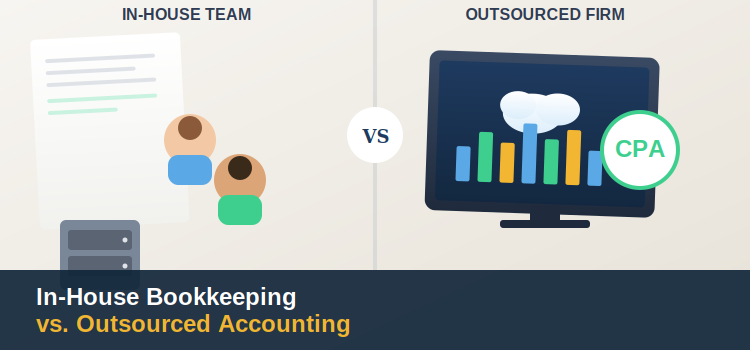
A full-time in-house bookkeeper costs $60,000–$98,000 per year once salary, benefits, payroll taxes, software, and overhead are counted not the $45,000–$65,000 base salary most owners budget for. Outsourced bookkeeping and accounting typically runs $300–$2,500 per month ($3,600–$30,000/year) for equivalent scope. Most small businesses under $5M in revenue save $40,000–$60,000 annually by outsourcing, and recover 5–10+ hours a week previously spent managing books or supervising staff. In-house hiring generally only wins once transaction volume, headcount, or compliance complexity is high enough to justify a dedicated, full-time seat usually well past the $1M–$5M revenue mark.
Why This Decision Is Bigger Than It Looks
Most business owners frame this as a simple question “should I hire someone or pay a service?” and price it off a single number: the salary line on a job posting, or the monthly fee on a service’s pricing page. That comparison is misleading in both directions. In-house hiring has significant hidden costs beyond salary, and outsourcing has a wider range of scope and quality than a flat monthly fee suggests. This guide breaks down the real, fully-loaded cost of each model, the time cost most owners never account for, and a decision framework based on where your business actually stands.
The True Cost of In-House Bookkeeping
It’s Never Just the Salary
The salary is the visible number. The real cost is salary multiplied by roughly 1.25–1.4x, once you add:
| Cost Component | Typical Range |
|---|---|
| Base salary (bookkeeper) | $45,000–$65,000/year (median: $49,210, BLS) |
| Employer payroll taxes (Social Security, Medicare, FUTA/SUTA) | ~10–12% of salary |
| Health insurance contribution | $6,000–$15,000/year |
| Paid time off, holidays, sick leave | 15–20 paid non-productive days/year |
| Recruiting & onboarding | 10–20% of first-year salary (~$4,000 average hiring cost) |
| Software licenses (accounting, payroll, expense tools) | $600–$2,000+/year |
| Equipment & office overhead | Computer, desk, workspace, utilities |
| Fully-loaded annual cost | $60,000–$98,000/year |
In high cost-of-living metros (New York, San Francisco, Los Angeles), these figures run 15–25% higher still. And if your bookkeeping needs controller-level oversight on top of day-to-day entry, that typically requires a second hire adding $125,000–$185,000 more.
The Cost Owners Almost Always Forget: Management Time
Beyond the direct dollars, an in-house hire adds a cost that never appears on a P&L line: your own time. Performance reviews, resolving payroll questions, managing PTO schedules, and general oversight all fall on the business owner or a manager time that isn’t billed anywhere but is genuinely spent.
Coverage Risk
An in-house bookkeeper is a single point of failure. If they’re out sick, on vacation, or leave the role, financial tasks stall until they return or a replacement is hired and trained and turnover means restarting the ~$4,000, multi-week hiring and onboarding process from scratch.
The True Cost of Outsourced Accounting
Outsourced bookkeeping and accounting services generally price in one of three ways:
- Flat monthly subscription: the most common model in 2026, typically $300–$2,500/month depending on transaction volume and scope
- Hourly freelance rates: $25–$75/hour for bookkeeping, $150–$450/hour for CPA-level work
- Local firm retainer: $400–$800+/month, often reflecting the firm’s own commercial overhead
A mid-sized SMB package with both bookkeeping and light advisory support commonly lands around $1,500–$2,500/month ($18,000–$30,000/year) a fraction of a single fully-loaded in-house salary, while typically including a small team rather than one individual, which also solves the coverage-risk problem above.
What’s Usually Included (That Isn’t in the Sticker Price of In-House)
- Multiple people reviewing your accounts (built-in internal controls, rather than one person’s unchecked work)
- Continuous, year-round coverage no disruption from illness, vacation, or turnover
- Software and platform costs typically bundled into the fee
- Scalability cost adjusts with transaction volume instead of requiring a second hire
Side-by-Side: Total Annual Cost
| In-House Bookkeeper | Outsourced Bookkeeping/Accounting | |
|---|---|---|
| Base cost | $45,000–$65,000 salary | $3,600–$30,000/year (plan-dependent) |
| True fully-loaded cost | $60,000–$98,000/year | Same as quoted fee — no hidden load |
| Adding controller-level oversight | +$125,000–$185,000 (second hire) | Often available as a plan upgrade, not a second full salary |
| Typical small-business savings from outsourcing | — | $40,000–$60,000+/year for businesses under $5M revenue |
The Time Comparison
Cost is only half the equation time is the other half, and it’s just as real a cost even though it never shows up as a line item.
Time Spent by Business Owners Doing Their Own Books
- The average small business owner loses over 10 hours a month to manual bookkeeping tasks
- 41% of business owners spend 3–10 hours a month on payroll taxes alone; another 10% spend more than 10 hours
- If your time generates roughly $100/hour in revenue-producing work, spending 10 hours a week on bookkeeping represents an estimated $52,000/year in opportunity cost time not spent on sales, growth, or strategy
Time Spent Managing an In-House Hire
- Recruiting and onboarding a bookkeeper typically takes several weeks and roughly $4,000 in direct hiring costs
- Ongoing management reviews, PTO coverage, resolving questions consumes owner or manager time indefinitely, not just at hiring
- If the hire leaves, the entire cycle (weeks of vacancy, re-recruiting, retraining) repeats
Time Cost With Outsourced Accounting
- No recruiting, onboarding, or turnover cycle to manage
- Reporting is typically delivered on a fixed schedule rather than depending on one person’s day-to-day bandwidth
- Owner time shifts from managing the function to reviewing the output a materially smaller time commitment
Warning Signs You’ve Outgrown DIY (Before You Even Reach the In-House vs. Outsourced Decision)
- You’re processing more than 50 transactions a month
- You’re spending 5+ hours a week on bookkeeping yourself
- You’ve added employees, inventory, or multiple revenue streams
- You can’t say with confidence what you made last month
- Tax season regularly feels like an emergency
If several of these are true, the real decision isn’t “DIY vs. help” anymore it’s which form of help fits your stage.
When In-House Actually Wins
Outsourcing wins on cost and time for the large majority of small and mid-sized businesses, but in-house hiring can make sense once a business is well past early-stage complexity commonly cited thresholds are $1M–$5M in annual revenue or around 30 employees, where transaction volume and real-time, in-person availability start to justify a dedicated full-time seat. Below that threshold, most businesses don’t generate enough day-to-day bookkeeping work to keep a full-time hire consistently occupied meaning you’re often paying a full salary for partial-time value.
Decision Framework
| Your Situation | Better Fit |
|---|---|
| Under $1M revenue, simple transactions, few/no employees | Outsourced (fractional plan) |
| $1M–$5M revenue, growing complexity, still no dedicated finance seat | Outsourced (comprehensive plan with advisory) |
| $5M+ revenue, high transaction volume, need in-person, real-time support | In-house (often paired with outsourced advisory/CPA oversight) |
| Backlogged or messy books needing a one-time cleanup | Outsourced catch-up engagement, regardless of long-term model |
| Frequent, complex financing/investor conversations | Either model, but paired with dedicated CPA advisory |
Why This Is Where Accounting Solutions Comes In
Running these numbers side by side makes the pattern hard to ignore: for most small and growing businesses, in-house hiring quietly costs far more in dollars and in owner time than it appears to on paper, while a well-structured outsourced arrangement delivers the same reliability with none of the recruiting cycles, coverage gaps, or hidden overhead. That’s the gap Accounting Solutions was built to close. Instead of a single in-house hire who can be out sick, on leave, or gone entirely during a busy season, working with Accounting Solutions puts a full team behind your books bookkeeping, reconciliation, and CPA-level advisory working together on a predictable monthly fee, with none of the payroll tax, benefits, or onboarding costs of a full-time employee. Whether you’re currently doing your own books and losing hours you don’t have, or paying more than you realize for an in-house hire that isn’t fully utilized, Accounting Solutions can review your current setup and show you, in real numbers, exactly what the switch would save in both cost and time. If the comparisons in this guide sound familiar, that conversation is the logical next step.
Leave A Comment