
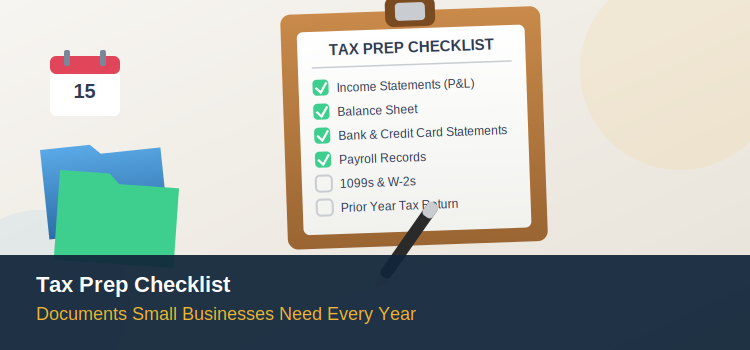
Every small business needs six categories of documents at tax time: entity paperwork (EIN, prior-year return), income records (1099s, invoices, bank statements), expense documentation (receipts, credit card statements organized by category), payroll and contractor forms (W-2s, W-9s, 1099-NECs), asset and deduction records (mileage logs, home office documentation, equipment purchases), and entity-specific paperwork (K-1s, shareholder basis worksheets, or operating agreements, depending on your structure). The IRS reports the average small business owner spends over 80 hours a year on federal tax prep nearly all of it avoidable with a simple system built during the year, not assembled in a scramble each spring.
Why This List Matters More Than It Seems
Tax prep isn’t hard because the tax code is complicated for most small businesses, it’s hard because the documents are scattered across a wallet, an inbox, a glove box, and three different bank accounts by the time filing season arrives. The IRS estimates the average small business owner spends more than 80 hours a year on federal tax preparation roughly two full work weeks and most of that time isn’t spent thinking about deductions, it’s spent hunting down paperwork that should have been filed correctly the first time.
The cost of getting this wrong isn’t just wasted hours. The IRS requires documentation for every deduction claimed, and unsupported deductions are among the fastest ways to lose them in an audit or trigger one. This checklist is organized the way a preparer actually works through a return, so you can build your own year-round system instead of a once-a-year scramble.
1. Foundational Entity Documents
Gather these first they don’t change year to year, but you’ll need them every time:
- EIN (Employer Identification Number) or Social Security Number, for sole proprietors without an EIN
- Prior-year tax return — used as a reference point and to carry forward prior-year information
- Business formation documents (articles of incorporation, LLC operating agreement) if not already on file with your preparer
2. Income Records
Every dollar the business earned needs to be documented, regardless of whether a 1099 was issued for it all income is taxable whether or not a 1099 arrives; the form documents income for the IRS, it isn’t permission to only report what’s formally reported to you.
- 1099-NEC / 1099-K forms received from clients or payment processors
- Invoices issued during the year
- Bank statements, 12 months, from every business account
- Sales records or point-of-sale reports, for product-based businesses
- Merchant processor statements (Stripe, Square, Shopify Payments, etc.)
3. Expense Documentation
These show what the business spent money on the goal at this stage is simply to gather and loosely group them by type, not to total or finalize anything yet.
- Receipts — digital or physical, organized by category where possible
- Business credit card and bank statements, 12 months
- Rent, lease, or mortgage records for business property
- Utility bills tied to the business (electric, internet, phone)
- Software subscriptions and recurring service charges
- Insurance premium statements
- Professional service fees (legal, accounting, consulting)
- Advertising and marketing costs
- Travel and meal expenses, with dates and business purpose noted
Organize these by category rent, supplies, insurance, advertising, professional services, travel, meals, software since your preparer will work through them systematically, and pre-sorted records save real time on the invoice.
4. Payroll and Contractor Forms
If you have employees or paid contractors, this category carries hard deadlines and real penalty exposure if missed.
| Form | Purpose | 2026 Deadline |
|---|---|---|
| W-2 | Reports employee wages and withholdings | Issue to employees by February 2, 2026 (Jan 31 falls on a weekend) |
| W-9 | Collects a contractor’s Taxpayer ID before paying them | Collect before first payment |
| 1099-NEC | Reports payments to independent contractors | File by February 2, 2026 for contractors paid $600+ in 2025 (threshold rises to $2,000 for 2026 payments) |
| I-9 | Verifies employee work eligibility | Maintain on file for all employees |
If you missed the January 31/February 2 deadline for W-2s or 1099s, file as soon as possible regardless late filing still results in lower penalties than not filing at all, and penalties increase the longer the delay. If a legitimate reason outside your control caused the delay, reasonable cause relief may apply keep documentation in case it’s needed.
5. Asset and Deduction Records
These are the records most commonly missing at tax time not because owners don’t know they exist, but because they’re rarely captured as they happen.
- Mileage logs — required if deducting vehicle use; you can deduct either the standard mileage rate or actual expenses based on business-use percentage, but you need contemporaneous records to support either method
- Home office documentation — the IRS requires the space be used exclusively and regularly for business; a corner of a shared room doesn’t qualify, but a dedicated room used only for work does
- Equipment and asset purchase records, including purchase date and cost, for depreciation
- Loan documents for any business financing, showing principal and interest separately
6. Entity-Specific Documents
Your business structure determines a second layer of paperwork beyond the basics above:
Sole proprietors: Schedule C is filed with your personal return no separate business return, but all the same documentation above applies.
Partnerships: Operating agreements, capital account statements, partner basis worksheets, and documentation for any special profit/loss allocations.
S corporations: Officer W-2 forms (owners who work in the business must be paid reasonable compensation via payroll, not just distributions), shareholder basis worksheets, and health insurance records for any owner with more than a 2% ownership interest.
C corporations: Corporate resolutions, dividend records, and documentation supporting any retained earnings decisions.
Key 2026 Filing Deadlines
| Deadline | What’s Due |
|---|---|
| February 2, 2026 | W-2s to employees and 1099-NEC forms to contractors (moved from Jan 31, which falls on a Saturday) |
| March 16–17, 2026 | S corporation (Form 1120-S) and partnership (Form 1065) returns due |
| April 15, 2026 | Sole proprietor and C corporation returns due; Form 4868 extension request deadline |
| October 15, 2026 | Extended filing deadline (if extension was filed) |
Important: An extension extends your time to file, not your time to pay. If you owe taxes, the estimated amount is still due by the original deadline interest accrues immediately on any unpaid balance from that date, regardless of extension status. The failure-to-file penalty is also significantly steeper than the failure-to-pay penalty, so even if you can’t pay in full, filing on time (or requesting an extension) matters more than waiting until you have the money.
Quick-Reference Checklist
EIN or SSN, prior-year return, entity formation documents
1099s and 1099-Ks received, invoices issued, 12 months of bank statements
Receipts and statements organized by expense category
W-2s and 1099-NECs issued to employees/contractors by February 2, 2026
W-9s collected from all contractors before payment
Mileage log or vehicle expense records
Home office measurements and exclusive-use documentation
Equipment/asset purchase records for depreciation
Entity-specific documents (K-1s, basis worksheets, operating agreements)
Documentation retained for at least 3 years (6 years if income was underreported by more than 25%)
Building a System So This Isn’t a Scramble Every Year
The habits that eliminate tax season stress take very little time individually they just need to be consistent:
- Keep business and personal finances completely separate. A dedicated business bank account and credit card create a clean paper trail and make categorizing expenses straightforward from day one, rather than requiring reconstruction later.
- File documents as they arrive, not at year-end. A simple folder structure income, expenses, payroll, assets, entity documents set up at the start of the year turns filing into a ten-second habit instead of an hours-long search later.
- Photograph or scan receipts immediately. Physical receipts fade and get lost; a photo taken the same day solves both problems permanently.
- Reconcile accounts on a regular schedule rather than only at tax time, so errors and missing documentation surface while they’re still easy to fix.
- Track mileage and home office use contemporaneously. Reconstructing a year of mileage from memory in April is far less accurate and far less defensible in an audit than logging it as it happens.
Why Professional Accounting Solutions Matter Here
A tax prep checklist only works if the underlying bookkeeping behind it is accurate and current a perfectly organized folder of receipts doesn’t help if the categorization inside your accounting software is wrong, or if six months of transactions were never reconciled in the first place. This is where Accounting Solutions removes the annual scramble entirely: instead of assembling this checklist from scratch every spring, our team keeps your books reconciled and your records organized year-round, so when tax season arrives, the documents your preparer needs are already accurate and ready not buried in a glove box or an inbox. We also track entity-specific requirements (reasonable compensation for S-corp owners, partner basis calculations, quarterly estimated payments) so nothing falls through the cracks between filings. If tax season has felt like a two-week fire drill in past years, that’s usually a sign the gap isn’t your effort — it’s the system behind it. Accounting Solutions can build that system once, so every future tax season starts from “ready” instead of “scrambling.”
Leave A Comment