
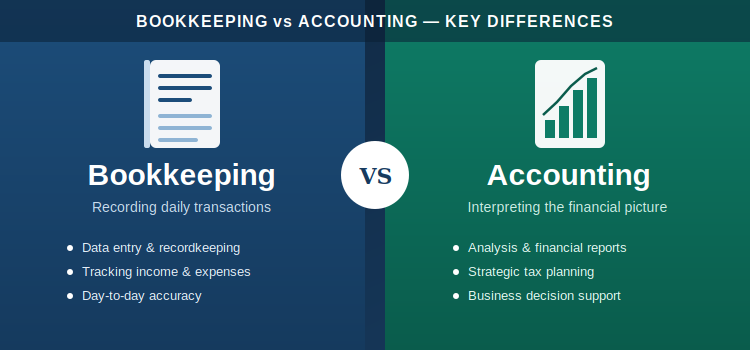
Bookkeeping is the day-to-day process of recording financial transactions sales, expenses, payments, and receipts. Accounting takes recorded data and interprets, analyses, and summarizes it to produce financial statements, tax filings, and strategic guidance. In short: bookkeepers record accountants interpret. One is not “better” than the other they’re sequential stages of the same financial process, and most growing businesses eventually need both.
What Is Bookkeeping?
Bookkeeping is the systematic, transactional recording of a company’s financial activity. A bookkeeper’s job is to make sure every dollar that enters or leaves the business is captured accurately and consistently, using source documents like receipts, invoices, and bank statements.
Core bookkeeping tasks include:
- Recording daily sales, purchases, and payments
- Managing accounts payable and accounts receivable
- Reconciling bank and credit card statements
- Processing payroll
- Categorizing transactions in a general ledger
- Maintaining supporting documentation for audits or tax filing
Bookkeeping generally follows one of two methods:
- Single-entry bookkeeping — tracks basic income and expenses, common for very small or simple businesses.
- Double-entry bookkeeping — tracks assets, liabilities, and equity alongside income and expenses, giving a fuller picture of financial health and forming the foundation most accounting standards require.
Bookkeepers typically don’t need a formal degree. Many enter the field through on-the-job training or a certificate program, though credentials like the Certified Bookkeeper (CB) from the American Institute of Professional Bookkeepers, or the Certified Public Bookkeeper (CPB) from the National Association of Certified Public Bookkeepers, signal a higher standard of expertise and are worth looking for when hiring.
What Is Accounting?
Accounting starts where bookkeeping ends. It takes the raw, categorized transaction data a bookkeeper produces and turns it into financial intelligence reports, forecasts, tax strategy, and compliance filings that guide real business decisions.
Core accounting tasks include:
- Preparing financial statements (income statement, balance sheet, cash flow statement)
- Analyzing financial trends and profitability
- Tax planning, preparation, and filing
- Budgeting and forecasting
- Ensuring compliance with tax law and financial regulations
- Advising on business structure, pricing, and growth strategy
- Conducting or supporting audits
Accounting is a broader field than bookkeeping and includes several specializations:
| Type | Focus |
|---|---|
| Financial accounting | Producing statements for external stakeholders, investors, lenders |
| Managerial accounting | Internal reporting to guide business decisions |
| Tax accounting | Compliance and tax strategy |
| Forensic accounting | Investigating fraud or financial discrepancies |
| Auditing | Independently verifying financial accuracy |
Accountants particularly Certified Public Accountants (CPAs) generally need a bachelor’s degree in accounting or a related field, and CPAs must complete 150 credit hours of postsecondary education, pass a rigorous four-part exam, meet supervised experience requirements, and complete continuing education annually to keep their license active. Certain services, like signing off on audited financial statements or representing a client before the IRS, are legally restricted to licensed professionals such as CPAs and Enrolled Agents (EAs).
Bookkeeping vs. Accounting: Side-by-Side Comparison
| Bookkeeping | Accounting | |
|---|---|---|
| Primary role | Recording transactions | Interpreting and analyzing financial data |
| Time orientation | Day-to-day, historical | Forward-looking and strategic |
| Output | Organized ledgers, reconciled accounts | Financial statements, tax filings, forecasts |
| Education needed | High school diploma + training, or certificate | Bachelor’s degree; CPA requires 150 credit hours |
| Licensing | Voluntary certifications (CB, CPB) | CPA license required for many advisory/audit services |
| Decision-making input | Minimal — records facts | Significant — advises on strategy, tax, compliance |
| U.S. median salary | ~$49,210/year (BLS, bookkeeping/accounting/auditing clerks) | ~$81,680/year (BLS, accountants and auditors) |
| Job growth (BLS projection) | Declining slightly due to automation | Growing, driven by regulatory complexity |
A Real-World Example
Imagine an e-commerce business doing $150,000/month in revenue.
The bookkeeper’s job: Log every Shopify sale, reconcile the merchant processor deposits against bank statements, categorize ad spend and shipping costs, and keep accounts payable current so vendors get paid on time.
The accountant’s job: Take that clean data and answer the harder questions Is the business actually profitable after fully-loaded costs? Should it elect S-corp tax status? What’s the projected tax liability for Q4? Should it raise prices given rising COGS?
Without the bookkeeper’s accurate records, the accountant has nothing reliable to analyze. Without the accountant’s interpretation, the bookkeeper’s data has no strategic value. They’re not competing functions they’re sequential ones.
Bookkeeper or Accountant: Who Should You Hire?
Hire a bookkeeper if you need to:
- Get caught up on messy or backlogged records
- Keep accounts payable/receivable current
- Reconcile accounts monthly
- Prepare clean data ahead of tax season
Hire an accountant (or CPA) if you need to:
- File business or personal taxes
- Get audited financial statements for a lender or investor
- Plan tax strategy or choose a business entity structure
- Interpret financial statements to guide growth decisions
- Navigate an IRS notice or compliance issue
Many businesses need both, often working together the bookkeeper feeding clean, current data to the accountant on a regular cadence. This is increasingly common as outsourced and fractional finance teams have made it affordable for small businesses to access both functions without full-time hires.
How AI and Software Are Changing Both Roles
Automation has meaningfully changed the day-to-day of bookkeeping. Modern accounting software can now bank-feed transactions, auto-categorize expenses, and flag anomalies work that used to be manually intensive. Industry-wide AI adoption in professional services nearly doubled between 2025 and 2026, and a growing share of accounting and tax firms now use generative AI tools daily. This shift means bookkeepers spend less time on manual data entry and more time reviewing, validating, and catching exceptions software might miss while accountants increasingly lean on AI-assisted analysis to spot trends faster, though the compliance judgment, tax strategy, and client relationship still require human expertise. Software has not eliminated either role; it has shifted both further toward oversight and interpretation.
Bookkeeping and accounting are two connected stages of the same financial process one focused on accurate recording, the other on interpretation and strategy. Getting the distinction right isn’t just semantics: it determines who you hire, what you should expect from them, and how prepared your business will be for tax season, lender due diligence, or growth decisions.
Accounting Solutions for Your Business
If your records are behind, inconsistent, or you’re unsure whether you need a bookkeeper, an accountant, or both, the right move is usually to combine the two rather than choose one. Cloud accounting platforms (such as QuickBooks Online, Xero, and FreshBooks) have made it easier to keep bookkeeping current with automated bank feeds and reporting, but software alone doesn’t replace professional judgment on tax strategy, compliance, or financial planning. Many small and mid-sized businesses now use outsourced or fractional accounting solutions pairing dedicated bookkeeping support with CPA-level advisory to get both functions covered without the cost of two full-time hires. Whatever path you choose, look for providers who are transparent about their qualifications (CB, CPB, CPA, or EA credentials), use secure, reputable software, and can clearly explain how their bookkeeping and accounting services work together to keep your business compliant and financially informed year-round.
Leave A Comment