
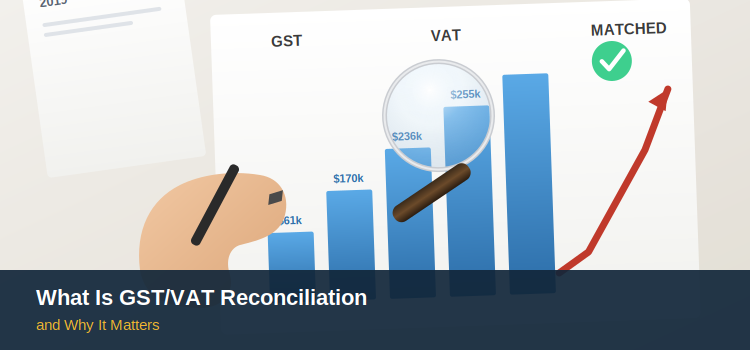
GST/VAT reconciliation is the process of matching the tax figures in your own accounting records against the tax data reported to the government supplier invoices, tax authority portals, and your filed returns to make sure they all tell the same story. It matters because mismatches are the single biggest trigger for tax notices, blocked input tax credit (ITC) or input VAT recovery, interest charges, and penalties. Done regularly, reconciliation protects cash flow, keeps returns audit-ready, and catches supplier or data-entry errors before they compound into a compliance problem.
What Is GST/VAT Reconciliation?
GST (Goods and Services Tax, used in countries like India, Australia, and Canada) and VAT (Value Added Tax, used across the UK, EU, and most of the world) work on the same underlying principle: businesses charge tax on what they sell (output tax) and can generally reclaim the tax they paid on business purchases (input tax), remitting only the net difference to the tax authority.
Reconciliation is the cross-check that confirms this system is working correctly. In practice, it means comparing:
- Your internal books — the sales and purchase registers in your accounting software
- Your filed returns — what you actually reported and paid to the tax authority
- Third-party data — invoices your suppliers or customers have reported on their own returns, which tax authorities increasingly auto-populate for you (such as India’s GSTR-2A/2B, generated from supplier filings)
When all three match, your input tax credit claims are defensible, your liability is accurate, and your filings are unlikely to trigger scrutiny. When they don’t match, it usually means one of a few things: a supplier hasn’t filed their return yet, an invoice was entered twice (or missed entirely), a tax rate was applied incorrectly, or a transaction was recorded in the wrong period.
Why GST/VAT Reconciliation Matters
1. It Protects Your Input Tax Credit (ITC) or Input VAT Recovery
This is usually the single biggest financial reason to reconcile. If an invoice you’re claiming credit on doesn’t appear in your supplier’s filed data, tax authorities can disallow or reverse that credit meaning you effectively pay the tax twice. Regular reconciliation surfaces these gaps early enough to follow up with the supplier before the credit is lost.
2. It Prevents Notices and Audits
Modern tax portals are increasingly automated and cross-check filings against third-party data in real time. A mismatch between what you’ve reported and what a supplier or customer has reported is one of the most common triggers for a formal notice or audit even when the underlying error was innocent (a timing difference, a duplicate entry) rather than deliberate.
3. It Avoids Penalties and Interest
Incorrect filings can carry direct financial penalties, and unpaid or underpaid tax accrues interest from the original due date, not from when the error is discovered. For a business with meaningful turnover, even a small percentage-based penalty can represent a significant, entirely avoidable cost.
4. It Protects Cash Flow
Both over-claiming and under-claiming input tax credit distort cash flow. Claim too much and you risk a reversal with interest down the line a liability that shows up later, often at the worst time. Claim too little (because you didn’t catch an eligible invoice) and you’re simply overpaying tax every filing period, tying up cash that should be staying in the business.
5. It Improves Vendor Discipline
Reconciliation isn’t only about your own records it quickly reveals which suppliers are inconsistent about filing their own returns on time. Since your ability to claim credit often depends on your supplier having correctly filed their side of the transaction, reconciliation gives you visibility (and leverage) to follow up with vendors whose late or incorrect filings are costing you money.
6. It Keeps Financial Statements Accurate
Beyond tax compliance, reconciled GST/VAT data feeds directly into your financial statements. Unreconciled tax accounts can misstate liabilities on the balance sheet and distort the true cost of goods sold meaning tax reconciliation issues can quietly undermine the accuracy of your broader financial reporting, not just your tax return.
How GST Reconciliation Works (India and Similar Systems)
In GST systems like India’s, reconciliation typically involves matching multiple government-generated returns against each other and against your books:
| Match | What It Confirms |
|---|---|
| Purchase register vs. GSTR-2A/2B | Whether your suppliers have actually reported the invoices you’re claiming ITC on |
| GSTR-1 vs. GSTR-3B | Whether the sales you declared match the tax liability you actually paid |
| Books vs. filed returns | Whether your internal records match what was submitted to the tax authority |
GSTR-2B, generated automatically from supplier filings, has become the primary reference point for what input tax credit a business is entitled to claim in a given period claiming credit outside what appears there carries real reversal risk.
How VAT Reconciliation Works (UK, EU, and Similar Systems)
In VAT systems, reconciliation centers on matching your VAT control account the master ledger of all VAT collected and paid against the VAT return actually submitted to the tax authority (such as HMRC in the UK), then investigating and clearing any differences.
Common sources of VAT mismatches include:
- Sales that were omitted from a return entirely
- VAT charged (or not charged) incorrectly on a transaction
- Timing differences between cash and accrual-based VAT accounting
- Cross-border transactions, where different countries’ VAT rules and reverse-charge mechanisms add complexity
- Cross-border digital services and evolving low-value import rules, which have added new reconciliation categories for many businesses trading internationally in 2026
For businesses selling internationally, VAT reconciliation carries extra complexity: high transaction volume, constantly updated cross-border rules, and the practical challenge of getting accurate, timely data from tax jurisdictions your business isn’t physically based in.
Common Causes of GST/VAT Mismatches
- Supplier filed late, incorrectly, or not at all
- Duplicate invoice entries in your own books
- Invoices missed or recorded in the wrong tax period
- Incorrect tax rate applied to a transaction
- Credit notes or amendments not reflected on both sides
- Manual data entry errors, especially at high transaction volume
- Currency or cross-border transactions with different reporting rules on each side
Best Practices for Reconciliation
- Reconcile monthly, not just at filing deadlines. Catching a mismatch early gives you time to contact the supplier or correct the record before the return is due waiting until the deadline turns a five-minute fix into a scramble.
- Match at the invoice level, not just the summary total. Two numbers can match in aggregate while hiding offsetting errors underneath invoice-level matching is what actually catches the mismatch.
- Follow up with non-compliant suppliers directly. If a vendor consistently files late, your credit is consistently at risk track this rather than treating each occurrence as isolated.
- Keep reconciliation records, not just the final return. If a notice or audit does arrive, being able to show your reconciliation workpapers is far stronger evidence of good-faith compliance than the return alone.
- Use reconciliation or accounting software for volume. Once a business is processing more than a small number of transactions a month, manual matching becomes error-prone and time-consuming automated matching tools are increasingly considered standard practice rather than optional.
- Reconcile before, not after, claiming credit. Confirming an invoice appears in the government-side data before claiming input tax credit avoids the reversal-and-interest cycle entirely.
Why Professional Accounting Solutions Matter Here
GST/VAT reconciliation sits at the intersection of bookkeeping accuracy and tax compliance, which is exactly why it’s one of the areas where professional support pays for itself fastest. A bookkeeper who reconciles tax accounts monthly rather than scrambling before a filing deadline catches supplier mismatches and data entry errors while they’re still a quick fix. A qualified accountant, tax advisor, or GST/VAT specialist adds the layer that software alone can’t: judgment on whether a disputed input tax credit is defensible, how to handle cross-border or multi-jurisdiction transactions correctly, and how to respond if a mismatch has already triggered a notice. Reconciliation software can flag that two numbers don’t match; it takes professional expertise to know why they don’t match and what to do about it. For any growing business especially one trading across multiple states or countries pairing reliable bookkeeping with knowledgeable tax and accounting support isn’t just about avoiding penalties. It’s what keeps eligible credit from quietly leaking out of the business every single filing period.
Leave A Comment